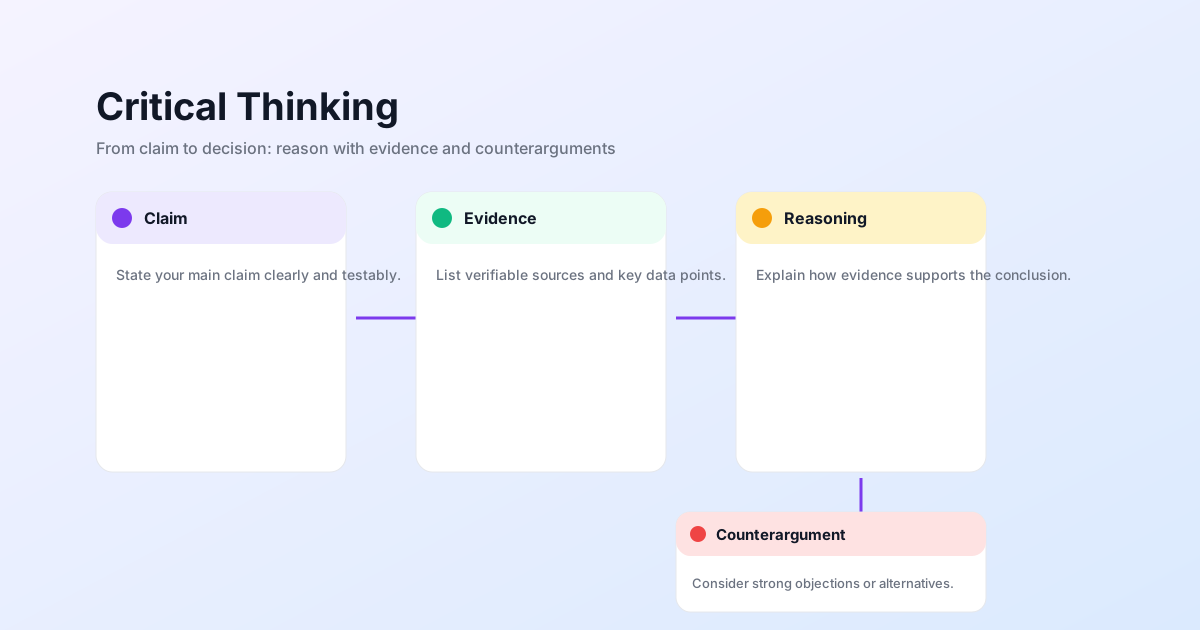
Critical Thinking

Evaluate claims and evidence with a structured approach, spot logical fallacies, and make resilient judgments

Thinking ModelCognitive EfficiencyDecision MakingProblem Solving
Estimated time: 20 min
Difficulty: Beginner
Enhances Cognitive Efficiency

Thinking Model Definition & Principles

Critical Thinking is a systematic approach to evaluating claims and evidence. With structured questioning and verification, you can spot logical fallacies, assess information quality, and make resilient decisions.

This thinking model can significantly enhance your cognitive efficiency and decision-making abilities, helping you solve complex problems more effectively. By applying this model, you can improve your time management efficiency and overall productivity.
Critical Thinking Frameworks

Paul-Elder Framework

Evaluates thought quality across eight elements: purpose, question, information, concepts, inferences, point of view, assumptions, and implications.

Primary focus

  • Clarify purpose and key question
  • Audit source credibility
  • Uncover assumptions and implications

Facione Critical Thinking Skills

Highlights interpretation, analysis, evaluation, inference, explanation, and self-regulation as transferrable skills.

Primary focus

  • List evidence-to-claim links
  • Compare alternative viewpoints
  • Reflect on personal bias

Pearson RED Model

A workplace-oriented cycle: Recognize Assumptions, Evaluate Arguments, Draw Conclusions.

Primary focus

  • Surface hidden assumptions
  • Stress-test argument strength
  • Summarize conclusions with next actions

How to Apply This Thinking Model

Below are the specific steps to apply this thinking model to enhance your cognitive efficiency and decision-making abilities. Following these steps can significantly improve your time management and problem-solving efficiency.

1

Define the Claim

State the claim or conclusion you want to evaluate in one sentence.

Tips

  • Avoid ambiguity
  • Make it testable
2

Gather Evidence & Reasoning

List key evidence for or against the claim and explain how it supports the conclusion.

Tips

  • Separate facts from opinions
  • Correlation is not causation
3

Analyse Assumptions & Biases

Inspect hidden assumptions, logic gaps, and potential cognitive biases in the argument.

Tips

  • Use Paul-Elder elements to audit reasoning
  • Document counterpoints explicitly
4

Synthesize Judgment & Actions

Balance evidence strength and risk to form a conclusion with follow-up actions.

Tips

  • Clarify conditions and limitations
  • Plan validation or monitoring steps

Thinking Model Application Cases

Below are practical application cases of this thinking model in real-world scenarios, demonstrating how it enhances cognitive efficiency, time management, and decision-making abilities. These cases can help you better understand how to apply this model to your own work and life.

News Credibility Check

Assess the credibility of a news article with the Claim–Evidence framework

Scenario

Highlight the claim, sources of evidence, and potential counterarguments

Outcome

By applying this model, problems can be effectively solved and expected results achieved.

Companion Templates & Case Structures

Load these templates in the tool to jumpstart critical thinking practice

News Fact-Check

Fact-check workflow

Assess the credibility of public news topics with cross-source validation.

  • Combine official and third-party datasets
  • Remind to review methodology and station changes
  • Highlight documenting meteorological or other factors
Tip: open the tool and use "Featured Templates" to load the full structure.

Product Claim Evaluation

Experiment + Funnel Analysis

Evaluate product iteration impact on key metrics with attention to experiment design and channel mix.

  • Combine A/B experiment results with funnel metrics
  • Remind to control acquisition channel mix and seasonality
  • Highlight continued monitoring before full rollout
Tip: open the tool and use "Featured Templates" to load the full structure.

Paul-Elder Classroom Review

Paul-Elder Framework

Evaluate classroom discussions or essays by focusing on purpose, questions, and assumptions—ideal for education.

  • Prompts to review purpose, key questions, and assumptions
  • Encourages citing class materials and external sources
  • Adds counter viewpoints to avoid groupthink
Tip: open the tool and use "Featured Templates" to load the full structure.

RED Decision Retrospective

RED Model

Supports product/ops teams in retrospectives by identifying assumptions, evaluating arguments, and drawing conclusions.

  • Map assumptions to supporting evidence
  • Capture dissenting views to avoid confirmation bias
  • Summarize conclusions into next-step actions
Tip: open the tool and use "Featured Templates" to load the full structure.

Workplace Risk Assessment

Risk Control Framework

Designed for workplace briefings and exec reviews, balancing compliance, cost, and alternatives.

  • List regulatory requirements and internal policies
  • Include financial sensitivity analysis
  • Prompt contingency planning and accountability mapping
Tip: open the tool and use "Featured Templates" to load the full structure.

Frequently Asked Questions

Top questions for education and workplace adoption

Logical reasoning checks structural validity; critical thinking expands to evidence quality, context assumptions, bias detection, and reflective judgment.

Use our online tool to practice this thinking model and enhance your cognitive efficiency and decision-making abilities. This interactive tool can help you better apply the model principles, improving your time management and problem-solving efficiency.

Need classroom handouts or template packs? Open the tool and use the export feature (PNG / PDF).

Online Practice Tool

Use this interactive tool to practice thinking model principles, enhancing cognitive efficiency and decision-making abilities.

Open Free Online Tool
Critical Thinking – Thinking Model Guide | Zen of Thinking