SCAMPER Creativity Model

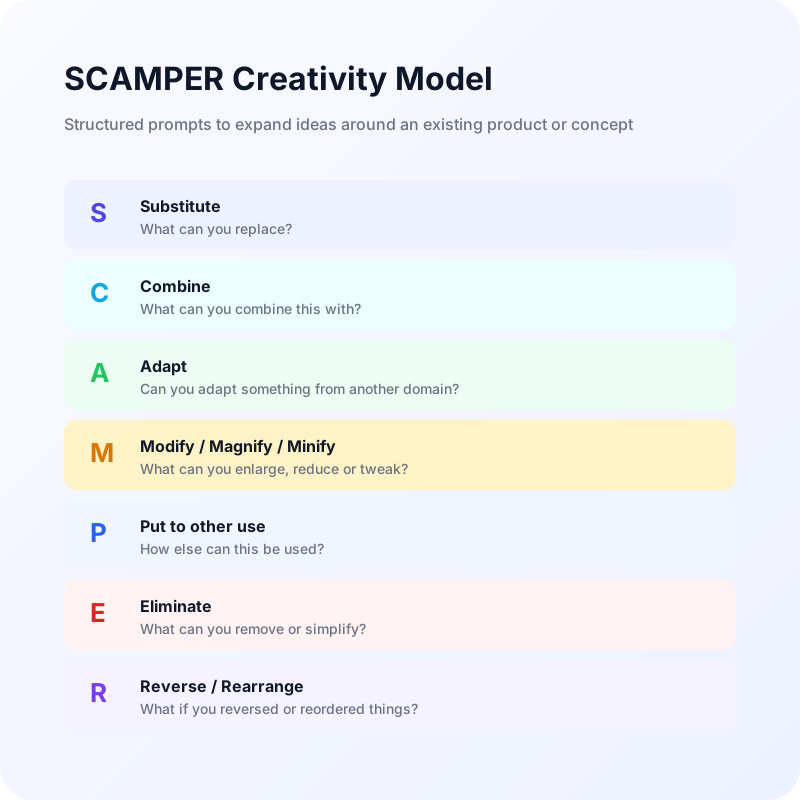
SCAMPER is a structured brainstorming checklist that helps you generate ideas by asking seven types of questions around an existing product, process or concept.

Thinking ModelCognitive EfficiencyDecision MakingProblem Solving
Estimated time: 25 min
Difficulty: Beginner
Enhances Cognitive Efficiency

Thinking Model Definition & Principles

SCAMPER was popularized by Bob Eberle as a practical way to spark ideas around something that already exists. Instead of starting from a blank page, you intentionally modify or reframe the current product, service, lesson or project through seven prompts.

The letters stand for S – Substitute, C – Combine, A – Adapt, M – Modify / Magnify / Minify, P – Put to other use, E – Eliminate, and R – Reverse / Rearrange.

This model is widely used in product development, marketing campaigns, innovation workshops, as well as classroom creativity exercises.

This thinking model can significantly enhance your cognitive efficiency and decision-making abilities, helping you solve complex problems more effectively. By applying this model, you can improve your time management efficiency and overall productivity.
To see where this model sits in a full problem-solving flow and how it combines with other models and tools, visit theThinking Playbookspage for stage-based chains by scenario.

How to Apply This Thinking Model

Below are the specific steps to apply this thinking model to enhance your cognitive efficiency and decision-making abilities. Following these steps can significantly improve your time management and problem-solving efficiency.

1

Choose the subject

Clarify what you want to improve: a product, a feature, a workflow, a service, or a lesson/activity.

Tips

  • Describe the subject in one sentence
  • Note key constraints such as time, budget and risk
2

Run through SCAMPER questions

Walk through S to R and ask targeted questions, such as "What can we substitute?" or "What can we combine this with?", and capture all ideas.

Tips

  • Separate idea capture from evaluation
  • Allow playful and wild suggestions in the first round
3

Cluster and refine ideas

Group related ideas, merge duplicates and start to see patterns (e.g., quick wins vs. big bets).

Tips

  • Tag ideas by user value, effort or risk
  • Highlight high-potential directions with color or labels
4

Select candidates and define actions

Pick the most promising 3–5 ideas and turn them into small experiments or action items.

Tips

  • Write down the next step for each idea
  • Note key assumptions that must be validated

Thinking Model Application Cases

Below are practical application cases of this thinking model in real-world scenarios, demonstrating how it enhances cognitive efficiency, time management, and decision-making abilities. These cases can help you better understand how to apply this model to your own work and life.

Improving an existing feature

Use SCAMPER to explore alternative ways to design or position a feature that users often complain about.

Scenario

For a bookmarking feature, you might substitute the trigger, combine it with recommendations or tags, or put saved items to a different use such as spaced review.

Outcome

By applying this model, problems can be effectively solved and expected results achieved.

Use our online tool to practice this thinking model and enhance your cognitive efficiency and decision-making abilities. This interactive tool can help you better apply the model principles, improving your time management and problem-solving efficiency.

Need classroom handouts or template packs? Open the tool and use the export feature (PNG / PDF).

Online Practice Tool

Use this interactive tool to practice thinking model principles, enhancing cognitive efficiency and decision-making abilities.

Open Free Online Tool
SCAMPER Creativity Model – Seven Prompts for Product & Idea Innovation | Zen of Thinking