First Principles

Break free from analogies and heuristics; derive solutions from fundamental truths and testable assumptions.

Thinking ModelCognitive EfficiencyDecision MakingProblem Solving
Estimated time: 20 min
Difficulty: Beginner
Enhances Cognitive Efficiency

Thinking Model Definition & Principles

First Principles is a bottom-up reasoning approach. Start from irreducible truths, add falsifiable assumptions and minimal validations, then derive actionable solutions, avoiding bias from analogies.

From Aristotle’s four causes to modern physics formulas (for example F = ma), first principles thinking spans science, engineering, and business. Elon Musk famously uses it to rebuild EV and rocket economics, while ML teams apply it to loss-function design and model selection.

This thinking model can significantly enhance your cognitive efficiency and decision-making abilities, helping you solve complex problems more effectively. By applying this model, you can improve your time management efficiency and overall productivity.
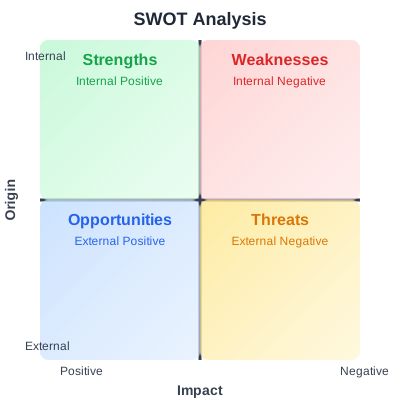
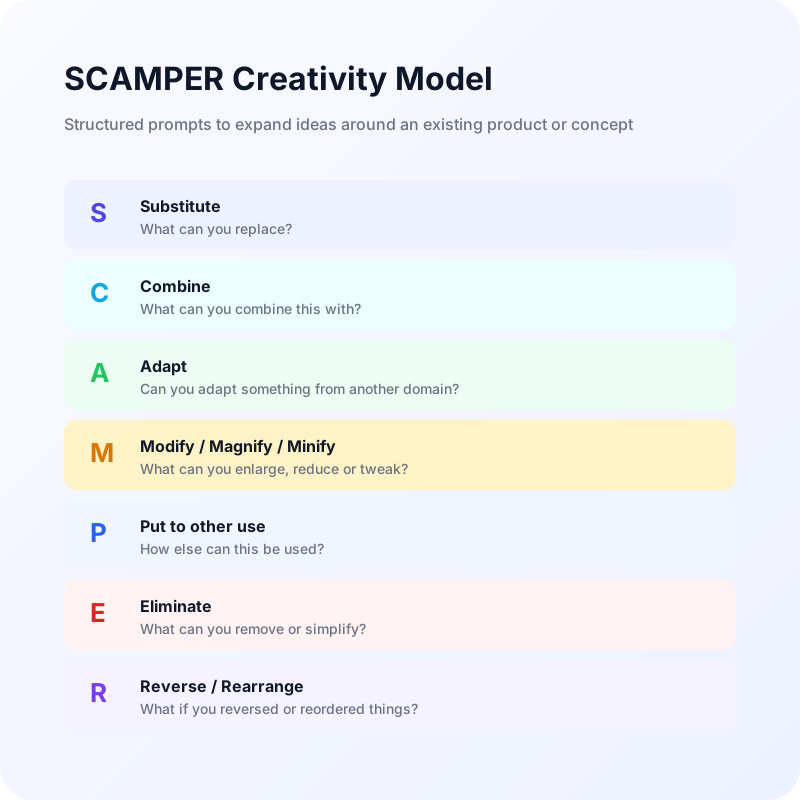
First Principles Framework Comparison

Philosophy / Musk / ML Loop

Philosophical Origins Sequence

Connect Aristotle’s four causes to Galileo and Newton, mapping propositions to formulas and modern applications.

Primary focus

  • List irreducible propositions
  • Build proposition → logic → formula chain
  • Translate to modern business contexts

Elon Musk Three-Step Breakdown

Define the problem, strip it to fundamental truths, rebuild the solution—great for cost innovation and hardware.

Primary focus

  • Identify constraints and goals
  • List physical/business truths
  • Recombine and validate solutions

First Principles ML Cycle

Anchor modelling decisions on target metrics, constraints, and validation loops.

Primary focus

  • Align objective function to business metrics
  • Balance constraints and regularization
  • Validate assumptions, iterate tuning

How to Apply This Thinking Model

Below are the specific steps to apply this thinking model to enhance your cognitive efficiency and decision-making abilities. Following these steps can significantly improve your time management and problem-solving efficiency.

1

Define Goal

State your goal or challenge in one sentence.

Tips

  • Clear and testable
  • List constraints separately
2

Identify First Principles

List propositions independent of analogy or experience.

Tips

  • Backed by logic/science
  • Don't start from 'how others do it'
3

Form Assumptions and Validation

Turn heuristics into falsifiable assumptions with minimal tests.

Tips

  • Small steps with quick feedback
  • Prioritize high-impact variables
4

Derivation and Conclusion

Derive steps and decisions from principles and test results.

Tips

  • Close the loop to actions
  • Keep rollback and boundaries

Thinking Model Application Cases

Below are practical application cases of this thinking model in real-world scenarios, demonstrating how it enhances cognitive efficiency, time management, and decision-making abilities. These cases can help you better understand how to apply this model to your own work and life.

EV Cost Rebuild

Rebuild cost path from materials and process fundamentals

Scenario

Use energy density, scaling effects, weight saving as principles; form tests and strategies

Outcome

By applying this model, problems can be effectively solved and expected results achieved.

First Principles Featured Templates

Load these templates in the tool to practise Elon Musk-style breakdowns, formula derivations, and ML modeling.

EV Cost Rebuild

Materials & Structure Framework

Break down EV cost levers through energy density and scaling principles to support structured cost-reduction strategy.

  • Material vs. structure trade-offs
  • Validation cadence: pilot → scale
  • Falsify high-cost variables first
Tip: open the First Principles tool, load a featured template, then export as PNG/PDF.

Quick Site Building

Constraint Decomposition Framework

Operations-focused template that helps marketing teams make rapid site-building decisions within clear constraints.

  • Complexity vs. delivery speed
  • Explicit constraint listing
  • Validate the “minimum viable” option
Tip: open the First Principles tool, load a featured template, then export as PNG/PDF.

A/B Test Strategy

Experiment Design Framework

Data team oriented breakdown that highlights hypothesis testing and power analysis essentials.

  • Power analysis references
  • Confounder controls
  • Stop criteria
Tip: open the First Principles tool, load a featured template, then export as PNG/PDF.

ML Modeling from First Principles

Objective → Constraints → Model structure

Emphasizes deriving model structure from target metrics for ML and data teams.

  • Loss function design
  • Regularization vs. generalization error
  • Experiment logging template
Tip: open the First Principles tool, load a featured template, then export as PNG/PDF.

Philosophical Roots & Formula Derivation

Proposition-Logic-Formula sequence

Education-focused template summarising philosophical origins and formula derivations.

  • Aristotle’s four causes
  • Derivations from Galileo to Newton
  • Mapping formulas to business/product contexts
Tip: open the First Principles tool, load a featured template, then export as PNG/PDF.

Frequently Asked Questions

Top questions for education and workplace adoption

It is a reasoning approach that breaks a problem down to irreducible truths, then rebuilds solutions from the ground up. Instead of relying on analogy, you identify fundamental facts, form hypotheses, and test them.

Use our online tool to practice this thinking model and enhance your cognitive efficiency and decision-making abilities. This interactive tool can help you better apply the model principles, improving your time management and problem-solving efficiency.

Need classroom handouts or template packs? Open the tool and use the export feature (PNG / PDF).

Online Practice Tool

Use this interactive tool to practice thinking model principles, enhancing cognitive efficiency and decision-making abilities.

Open Free Online Tool
First Principles – Thinking Model Guide | Zen of Thinking